Blog · 12 September 2026 · Jon McLachlan
Ten rows. One engagement.
The comparison page has ten rows, five columns and a date. This is the long version. What a firm of two to fifty people loses at each row, what Ignition, Anchor, the time trackers and the suites do about it in their own documentation, and what Ceed does, with the two things before the first row and the two after the last, which stay with the tools a firm already has. With twelve recordings, two posts from X, five figures, pictures of the product, seven books and three episodes of The Security Podcast of Silicon Valley. Correct as far as we know on 12 September 2026, and the comparison page was changed the same day where the reading called for it.
The comparison page is a table. One row for each step of an engagement, in the order the engagement happens, and a column each for Ceed, Ignition, Anchor, the time trackers and the professional services suites. Every cell reads Built, Yes, No or Partial, and the page carries the date it was last checked. A table can say what a product does. It cannot say what it costs a firm of eight when the product does not do it, or what the field’s Yes looks like at three in the morning. This post takes the rows one at a time.
Three things per row. The pain, in the numbers and in the words of the people who run these firms. What the field does about it, taken from the vendors’ own help centers and pricing pages as they read on 12 September 2026, because a help center is where a product tells the truth about itself and a home page is where it tells the story. And what Ceed does, and where the tools a firm already uses stay, said in the same type as the rows it wins. Where the reading corrected the comparison page, the correction is listed near the end, and the page was changed the same day.
The field, for the purposes of this post. Ignition and Anchor sell the agreement and the collection: a proposal the client signs with a payment method attached, and invoices that pull themselves. The time trackers, Harvest, Toggl Track, Clockify and Hubstaff, with Everhour beside them, sell the hour: timers, timesheets, budgets and alerts. The suites, Accelo, Scoro, Kantata and Productive, sell the whole operation to firms large enough to implement one. Each is good at the thing it sells. The rows are where the things it sells meet the things a firm has to do anyway.
Before the first row. The agreement and the money.
The table begins at the hour, and two things happen before it: the proposal becomes a signed agreement, and the client authorizes the firm to be paid, after which invoices pull themselves. Ignition and Anchor do both, and do them well, so this is where the field is credited before the rows begin.
Start with the document. Of the claims asserted in 2023 against CPA firms in the AICPA Professional Liability Insurance Program, about three quarters came from tax work, and of those, more than half had no engagement letter at all, The Tax Adviser reported in November 2025. Sarah Beckett Ference, a risk control director at CNA, the program’s underwriter, wrote in the Journal of Accountancy in April 2026 that an advisory engagement “is determined solely by the agreement between the accountant and client,” and that when the agreement is vague or not written down, “accusations can fly and fingers can point.” She also wrote the sentence that turns the agreement into the second row: even with a good letter, “the scope of a CAS engagement often changes after it starts.” Her remedies, in order of formality, are a signed amendment, an email confirming the change and its effect on fees, or a change log reviewed with the client. All three are documents a person has to remember to write.
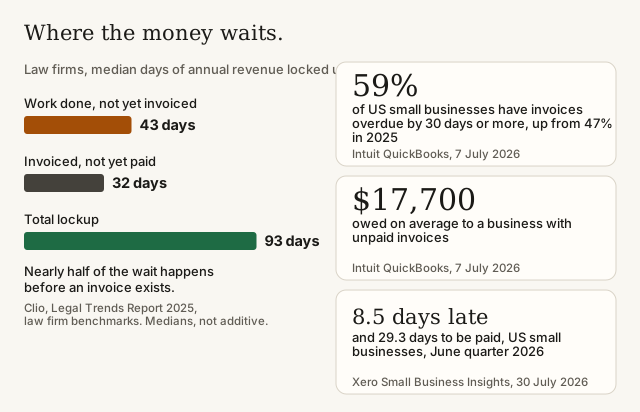
Then the money, which starts waiting the day the document is signed. Intuit QuickBooks’ 2026 Late Payments Report, published 7 July 2026 from a quarterly survey of about 5,000 small business owners and a December 2025 survey of 1,305, found 59% of small businesses with invoices overdue by thirty days or more, up from 47% a year earlier, and $17,700 owed on average to a business with unpaid invoices. Xero’s ledger data for the June quarter of 2026 had US small businesses paid 8.5 days late on average and waiting 29.3 days to be paid, the wait longer than the quarter before because firms had lengthened their own terms. Ignition’s 2025 survey of 273 agency leaders found 84% spending three to ten or more hours a month chasing late payments, 71% with at least one invoice in four paid late, and only 20% using billing with automated payment collection. Clio’s 2025 benchmarks, drawn from tens of thousands of law firms, put the median lockup at 93 days of annual revenue: 43 days of work done and not yet invoiced, then 32 days of invoices sent and not yet paid. Nearly half of the wait happens before an invoice exists.
Ignition, founded in 2013, sells exactly this problem’s remedy to accountants and agencies. Proposals, engagement letters from vetted templates, e-signature, and payment details captured at acceptance so that signing “automatically sets up the billing: schedules, payment terms, and invoicing.” Its year-end release of 4 December 2025 counted 8,500 or more customers, $3.1 billion through the product in 2025 and 91% of payments collected automatically, a figure it first published in May 2025 when it launched AutoCollect, which imports unpaid invoices from QuickBooks Online and Xero and invites clients to pay from a portal with a saved method. Instant Bill, from August 2023, charges a flat amount for out-of-scope work without a new proposal. In the same release Ignition says 78% of its customers reduced late payments and 85% saw less scope creep, both figures about its own base. Anchor, funded with a $20 million Series A in January 2025, makes the payment method a precondition of signature: “Require clients to add a payment method before allowing them to sign agreements,” then “Trigger invoicing and payment collection automatically once your agreement is signed.” Its pages say more than 21,000 firms, and its Series A release said agreement signing time fell from over 45 days to under 24 hours, a claim without a sample. Both collect money well, and on these two rows the comparison page says so.
Neither knows what the engagement cost, and neither tracks an hour. Ignition’s integrations page lists ledgers, practice management tools, Gusto, Zapier and Slack, and no time tracker. Its dashboard reports projected revenue, payments, proposals and revenue by service, and no cost. Anchor reads hours only once they have landed in QuickBooks Online from a tracker synced to it, QuickBooks Time, BigTime, Toggl and Harvest at the June 2025 launch, and checks them “against the pre-approved hourly cap” when the invoice is assembled. In both, the agreement is the schedule the client will be charged on. It is not the set of rules the hours are checked against while the work is being done, which is what the first two rows are about.
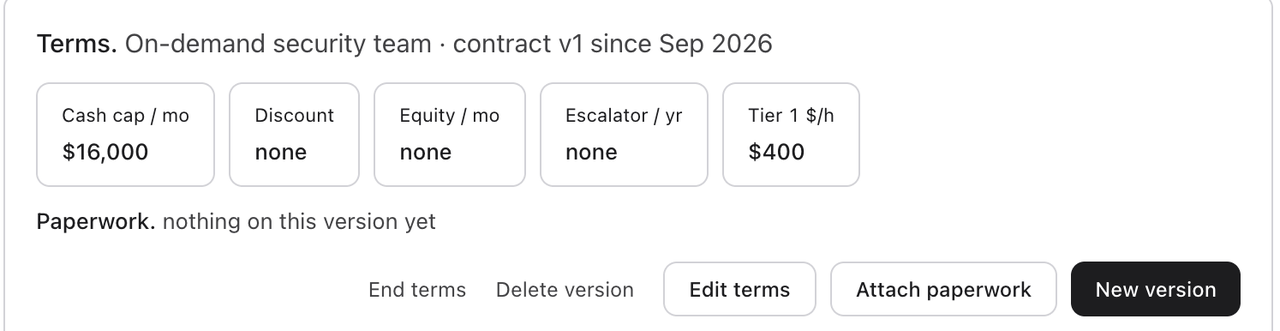
In Ceed the agreement is a terms card: the monthly cap, the rates by tier, the discount, the yearly escalator, any equity taken as payment, versioned, with the signed paperwork attached to the version. Every hour logged against the client is checked against those terms as it is logged. The signing happens before Ceed and the collecting after it. A firm signs its proposal wherever it signs today, in Ignition or Anchor or by email, enters the terms on the card, and the invoice comes out of Ceed as a frozen document that its bank, or Ignition, or Anchor, collects. Ceed is the record between the two. It never touches the money.
Jonathan Stark, who has spent a decade arguing that consultants should be paid before the work, has seven minutes on why to ask for the whole fee up front, even when you expect a no. It is the shortest argument for row two that exists.
One minute a day. From Slack.
The first row is the hour itself. Everything after it is computed from entries a person made, so the row is about whether the entries get made, and whether they are true.
The people who have watched the most timesheets do not think they are. Blair Enns, on 2Bobs in March 2026: “My fundamental problem with timesheets is it’s like the drunk looking for his car keys under the street lamp, not because he lost them there, but because the light’s better there.” David C. Baker, in the same conversation: “The only timekeeping sheets that are accurate are from contractors who get paid for what they do,” and “On the employee side, there’s probably more lies in timesheets than anywhere else.” The measurement behind those opinions has not changed since AffinityLive, now Accelo, surveyed more than five hundred professionals in 2014 and found time logged daily 66% accurate and time logged weekly 47%. Harvard Business Review’s write-up of the same research in January 2015 put the cost of unrecorded work at 50 million hours a day in the United States. Nothing newer with a sample has been published since, by anyone in the table.
The people filling the sheets say why. When a company that automates lawyers’ time tracking launched on Hacker News in March 2024, 137 points and 118 comments, a former consultant named bdamm wrote that he had left the career track over it: “it turns out I am not physiologically able to maintain 100% focus for my entire day. So it ends up being just creative lying, which I felt bad about.” noleary: “I don’t think I ever submitted my timesheet on time.” pkilgore, a former lawyer: “Too many 1am nights cleaning up my billing.” Six months later jiggawatts described the ratio the row is named for: “it takes me a solid minute to log in to my CRM web app to submit my timesheets for the day, a task that takes only 5 seconds.” And in November 2024 an agency operator explained on the same site why he had built a Slack app for it: “we used an external tool for time tracking, but I’d often forget my timesheets.”
The field agrees about Slack more than the comparison page gave it credit for, which is the first correction. Harvest has a command, “/harvest log,” documented “to log hours without starting and stopping a timer,” and sends timesheet deadline notifications into Slack. Toggl Track has “/toggl track” to add an entry by hand, and daily reminders “sent in the morning” by email or as a Slack direct message, on Premium and Enterprise. Clockify lists Slack among more than eighty integrations without a page saying what it does, and its own reminder is “Sent the next day if targets aren’t met,” on Standard and above. Hubstaff’s integrations overview lists no Slack at all. Its model is the desktop timer with activity levels and screenshots. Everhour’s Slack app posts daily and weekly summaries and time off, and logs nothing. Among the suites, Productive’s Slack app makes tasks and shares reports, Scoro’s sends notifications as direct messages, Kantata’s posts activity and is on the Enterprise plan, and none of them logs an hour. Ignition and Anchor have no hour to log. So the row reads Yes for the trackers and the suites, and the difference is what the minute contains.
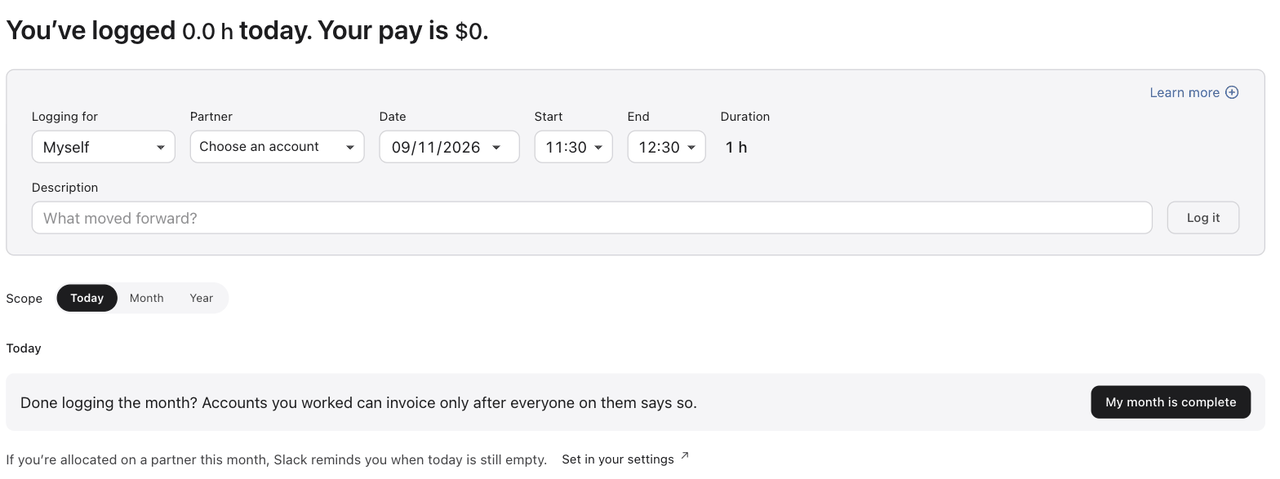
In Ceed the minute is one Slack message each workday, sent only when today is still empty, carrying the hours left on each client you are booked to. The reply is the entry: the client, the hours, a line on what it was. No timer, no screenshots, and everyone sees their own hours and their own pay for the day. Because the reminder carries the budget, the person logging knows before the hour whether it will cross, which is the second row. And the month cannot invoice until each person who worked on the account has said their month is complete, which turns the deadline the field’s reminders chase into a rule the invoice waits for.
The strongest case against the row is the one Jonathan Stark and Chris Do made to 276,000 people: stop selling hours, and the timesheet goes away with them. It is the right argument for a solo consultant pricing a project. For a firm of ten with a flat retainer sized in hours only the owner knows, the hours still have to be counted somewhere, which is the private budget this blog keeps returning to.
And the agency version, from the two people quoted above. David C. Baker and Blair Enns spent half an hour in October 2020 on what a firm can and cannot do with a timesheet, and it is where the figure that the average firm captures 42% of its time rather than 60% comes from.
The moment it crosses. Or the morning after.
Row two is the one the comparison page was written around, and this blog has a post on the mechanism, Held. Not hidden. This section is about the other four columns: what each tool does when an hour would push a client over budget, in the tool’s own words, and when.
The pain has fresh numbers. Teamwork.com’s survey of more than a thousand senior services leaders for 2026 found 66% saying clients are “more demanding but less willing to pay for work,” and 27% naming clients moving the budget in the middle of a project as their top frustration. Ignition’s 273 agencies: 57% lose $1,000 to $5,000 a month to unbilled work, a further 30% lose more than $5,000, and 78% rarely or only sometimes charge for out-of-scope work. Law firms measure the same thing as write-downs. Thomson Reuters surveyed 245 partners at firms of eleven lawyers or more in 2023 and found 43% reducing a bill because the time exceeded the partner’s own expectations, against 14% who reduced it because they feared the client would challenge it. The same study put silent write-downs, hours never entered at all, at over 76 hours and nearly $47,000 per partner per year. Its 2025 survey of 315 attorneys found the average partner writing down 300 hours of their own time a year. Ryan Lazanis, who coaches accounting firms, wrote on 8 September 2026 how the overrun is usually found: “It’s rarely one dramatic moment. It’s a quick question here, a form there, an email thread that grows.”
Never do “secretly free” scope changes. “Strategically free” is OK... as long as you tell the client they’re getting something special.
Here is what the field does at the crossing, read from the help centers on 12 September 2026. Harvest’s home page says “Live alerts. Get notified before you go over.” Its help center says budget emails “are sent the morning after a project goes over the percentage threshold you set,” generated at 3:00 a.m. Eastern, then weekly until the project is archived. Clockify’s budgeting page says you can “instantly compare actual costs to your estimates,” and its help center says alerts “are generated and sent at the 30-minute mark of each hour” and an alert “won’t appear instantly,” typically arriving by email within 30 to 40 minutes, on Pro and Enterprise, for every project with an estimate or for none of them. Toggl’s alerts are a Starter feature, and its documentation says a new alert “may take up to 30 mins to take effect,” with no delivery time published. Hubstaff refuses: members “cannot add time manually to their timesheet if the project’s budget has been reached,” a toggle stops timers at the budget, and only owners and organization managers can add the time anyway. Everhour refuses everyone: its budget settings “prohibit reporting time for anyone (including admins) if the budget is exceeded,” and stop running timers at the threshold. Productive, on its Professional and Ultimate plans, refuses at the keystroke with “You can’t track this amount of time on this service because it would exceed the limit,” or in its Budget cap mode accepts the entry and refuses its approval with “This entry cannot be approved because it exceeds the budgeted total for this service,” and a running timer is cut with “Entry shortened due to budget limit.” Scoro’s Watchdog emails you when a threshold is exceeded, on a schedule you choose, hourly or daily. Accelo fires one internal note to the project manager when a budget passes 90%. Kantata shows the percentage of budget used on a tab in the project’s admin box. Anchor checks tracked time against the pre-approved cap when the invoice is written. Ignition has no hour to check.

Three shapes, then. A report after the fact, which is Harvest, Clockify, Toggl, Scoro, Accelo and Kantata: the hour is in the record and the firm has already over-delivered by the time anyone reads the email. A refusal, which is Hubstaff, Everhour and Productive’s two limit modes: the budget holds and the hour leaves the record, which is the silent write-down Thomson Reuters measured, only now performed by software. A cap at the invoice, which is Anchor: the client is protected from the extra, and the firm has already worked it. Productive’s Budget cap is the nearest thing to a hold in the field, and it deserves the credit: the entry is kept and cannot be approved. What it lacks is the third piece, a named person asked for a yes or a no that day, with either answer on the record.
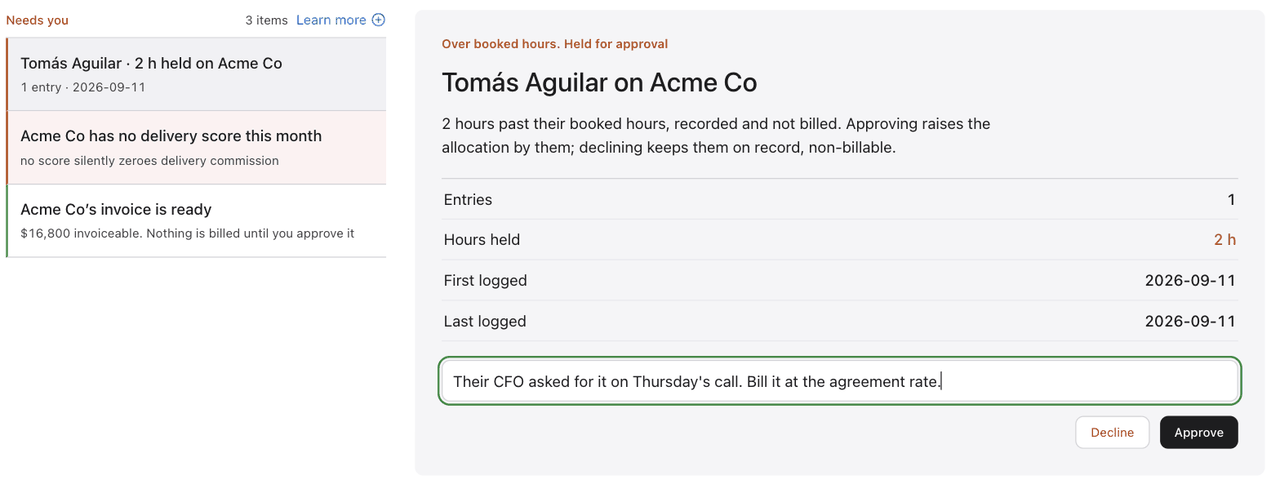
In Ceed the hour that would push a client over budget is saved, marked as held, and put in front of the account leader the moment it is logged. Approved, it goes on the invoice at the agreement’s rate with a name and a date on the approval. Declined, it stays on the record and off the invoice. Nothing is billed quietly. Nothing disappears. The agreement said 40 hours. The month said 47. shows the same hold as the change notice it replaces.
Parakeeto’s Agency Profit Podcast walked through a client of theirs in December 2025 that will sound familiar to any firm running a small core team and a bench of contractors: just under two million in revenue, weak time-tracking habits, a half-implemented project tool, and over-servicing that nobody could see until the numbers were rebuilt.
Computed from the agreement. Shares included.
Rows three and four are the invoice: computed from the agreement, with the budget, the approved extra and any equity taken as payment on it. The pain in row three is the gap between what the contract says and what the invoice says, and it is measured best where billing is a profession. Clio’s 2025 benchmarks: of the 3.0 hours a lawyer captures in an eight-hour day, 2.6 are invoiced and 2.4 collected. LexisNexis found in 2014 that 71% of law firms discounted or wrote off work before the invoice ever went out. Thomson Reuters’ 2026 rates report found worked rates up 7.4% against 2.8% inflation, and firms with opposite approaches to discounting nevertheless collecting roughly the same per hour, which means the rate card is not where the money is lost. In the wider economy, Versapay and Wakefield Research found in 2023 that 82% of companies had lost revenue to invoicing conflicts and that human error was the most common cause. For a firm of ten the error has a shape everyone recognizes: the approved extra never billed, the discount applied from memory, the cap clamped in a spreadsheet at month end, and a client who audits the result. A contractor on Hacker News in April 2024 described exactly that audit, a client questioning a period of more than twenty consecutive billed hours, and the defense being a contemporaneous record of what was done in them, which the auditor accepted.
What the field puts on the invoice is what the field has. Ignition bills the plan: the schedule in the signed proposal, with Instant Bill as a manual flat amount for anything outside it. Anchor computes hourly billing from hours that reached QuickBooks Online, clamped at the pre-approved cap. Harvest computes invoices from tracked time, expenses or fixed fees and is the only tracker with retainers, which only administrators can create and which cannot take on a new project once set up. Toggl’s invoice is an export: “Generated invoices are not saved within the Track app.” Clockify invoices from tracked time on Standard and above and “only allows percentage-based discounts.” Hubstaff invoices from tracked time on every plan. Everhour computes from rates and syncs the draft to the ledger, but if an admin later edits invoiced time, “it does not update the invoice automatically.” Productive puts invoicing on its top plan, Ultimate. Scoro runs quotes to invoices in its Quote to Cash apps. None of them prices an approved extra as its own line from a rule in the agreement, and none has a field for equity.
Row four is the one nobody in the table has. Firms that serve startups take shares as part of the fee, and have for a long time. In 2002 Fortune described a Cooley Godward client whose IPO would have earned the firm about $250,000 in fees, “on top of” which the firm held stock worth $5 million to $10 million shortly after the offering. A Cooley partner told the magazine that at the time “Everyone was requiring equity.” The firm took pre-IPO stock from 38 companies in 1999 and 59 in 2000, and the pile went from roughly $40 million at the start of 2000 to under $5 million by 2001. The practice is alive in 2026. Zypsy, a design agency, takes 1% of a startup through a SAFE for up to $100,000 of brand and product work over eight to ten weeks, TechCrunch reported in April 2024. Carta’s November 2025 data has the median advisor grant at 0.21% of a pre-seed company, 0.12% at seed and 0.05% at Series A, and the Founder Institute’s FAST agreement, revised in July 2026, sets 0.10% to 1.00% by stage and involvement. The field’s default advice is refusal. When a freelancer asked r/freelance in 2021 whether to take equity from an early client, the top reply at 53 points was “Run away. 98 times out of 100 this will be a time wasting deal for you,” and the 22-point reply beneath it: “the less someone pays the more changes they’ll ask for.”
Part of why the field says run is that nobody can book it. The rules exist. Under Section 83 of the tax code, restated in Revenue Ruling 2004-37, the fair market value of shares received for services is income to the provider in the year the shares vest. Under the revenue standard, ASC 606, noncash consideration is measured at contract inception and “Changes in the fair value of noncash consideration after contract inception are excluded from revenue,” as PwC’s guide puts it. So the fee is fixed on the day the contract is signed, in the firm’s books, at a number nobody on the engagement wrote down, because the invoice said $250,000 and the timesheet said hours.
In Ceed the equity is a term on the terms card, at the value you agreed, and the invoice is computed from the terms: the budget, the approved extra as its own line at the agreement’s rate, the discount, the equity taken as payment, and then frozen. Margin per client counts the shares at that value from the day the agreement takes effect, which is what your accountant will need in March. The valuation is the firm’s and its accountant’s, and so is the election. Every number on the invoice is computed from a rule and the record, the same way every time.
For the equity row, the clearest three minutes on how startups actually grant shares to the people who help them come from Eric Migicovsky, who founded Pebble and later worked at Y Combinator.
Margin this morning. Bookings against it.
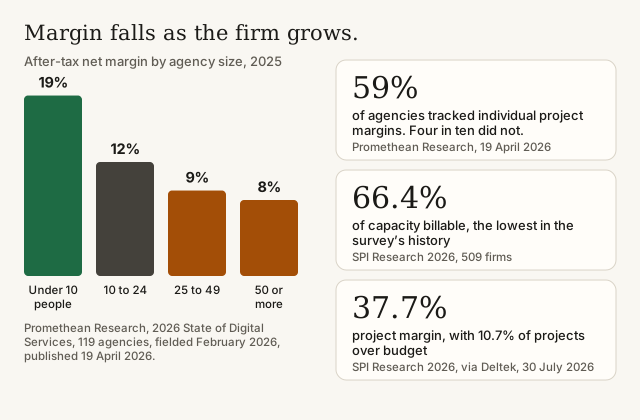
Rows five and six are the firm’s own view: margin per client, with the cost side, this morning, and people booked against both a client’s budget and their own availability. The pain in row five is the most measured number in this post. Promethean Research’s 2026 survey of 119 digital agencies, fielded in February 2026, found 59% tracking individual project margins, so 41% could not say which clients made money. The same survey has after-tax net margin at 19% for studios under ten people, 12% at ten to twenty-four, 9% at twenty-five to forty-nine and 8% at fifty or more. Margin falls across exactly the range Ceed is built for. SPI Research’s 2026 benchmark of 509 professional services firms has billable time at 66.4% of capacity, the lowest in the survey’s history, project margin at 37.7% and project overrun at 10.7%.
The stories match the numbers. Sapien, a UK advisory firm, published a case in June 2026 of a £3 million agency whose profit and loss “does not show margin by project, and it certainly does not flag which jobs lost money and why,” where a fifth of the client work was, in cash terms, free, and where measuring margin by project took net margin from 4% to 12% while billable time moved three points. In July 2026 an agency pricing consultant told r/agency about forty owners he had talked to, none of whom knew their real margin. One six-person marketing agency thought it ran at 30% “because thats what the spreadsheet said. Revenue - Salaries,” a spreadsheet that never counted the unpaid discovery calls, the free revision rounds or the Slack messages answered at nine at night. The pricing assumed 85% of time billable, the truth was 68%, and the real margin was 9%. In the same thread a former adviser described a boutique that grew from twenty people to three hundred in five years convinced it made 50% because it priced associates at twice their pay, “never made a meaningful profit,” and sold to Accenture because the alternative was running out of cash. His three leaks: discounts against list price, senior time doing work priced for junior time, and scope nobody charged for. When an agency asked the same forum in January 2025 what tool shows profit per client, the answers were “Toggl?” and “Accounting software and a spreadsheet.”
What the field shows, and when. Ignition and Anchor report revenue and payments, with no cost side and therefore no margin. Harvest’s profitability report is “only available on the Harvest Enterprise plan,” is run from the Reports menu, and has its own help article on fixing the missing cost rates that break it. Toggl’s profitability lives in reports on Premium. Clockify’s cost rates are on Pro and Enterprise, and profit appears when you generate a report per project with Show Profit switched on. Hubstaff’s report list has no profitability or margin report at all, and its budget reports show spend against budget. Everhour tracks what a person costs against what you charge, in reports, on its one paid plan. The suites report margin too, after the fact: Scoro’s margin is a Watchdog threshold or a report in its Advanced Finance add-on, Kantata’s dashboards state no refresh cadence, and Productive’s custom cost rates by person sit on Ultimate. None of them claims this morning, and none of them puts the number next to the client’s budget.
Row six is the same number seen forward. SPI’s 66.4% against the industry’s 75% target is roughly a day a week per consultant, unsold. Runn’s 2026 survey of the people who schedule delivery teams, with an undisclosed sample, found 44% still scheduling in spreadsheets and 9% who fully trust their scheduling data. Rob Black, who founded and runs Fractional CISO, wrote in November 2023 about the year he hired ahead of a straight-line revenue plan and cut staff in June: “Hiring in advance when you are missing your revenue plan does NOT work.” The suites are strongest here, and the page says so. Kantata’s Resource Center is the category’s benchmark, Scoro books people against a heat map of availability, Accelo schedules and reports use of time, and Productive books people against services on a budget, the closest anyone comes to booking against the agreement. Harvest sells scheduling as Forecast, a separate product on a separate bill at $5 a person a month billed annually or $6.25 monthly. Toggl’s Timeline is on Starter, Clockify’s scheduling on Pro and Enterprise, and Hubstaff’s scheduling is shifts and attendance. All of them book against people’s availability. Only Productive’s bookings know the budget.
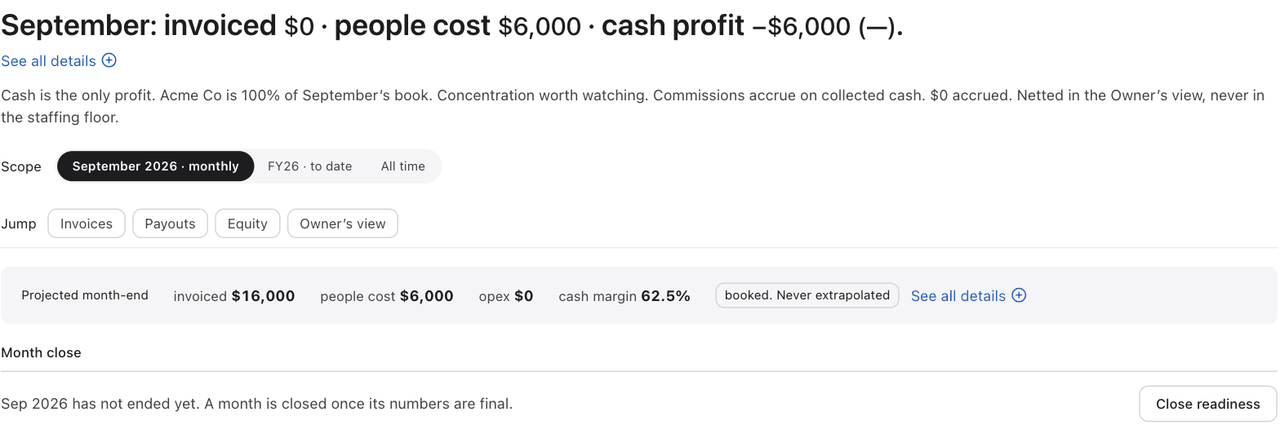
In Ceed every hour carries who worked it, at what pay, against which client and at which rate, so revenue, people cost and cash margin are computed for each client every day and shown to the owners and to whoever they name, with who may see rates and margin enforced on the server rather than in the screen. Bookings put a person on a client for the month against two numbers at once, the client’s remaining budget and the person’s remaining capacity, so the hour that will cross is visible before it is worked. Cash is the only profit Ceed reports, and the month end it projects is computed from what is booked, never extrapolated.
Drew McLellan, who runs the Agency Management Institute and has the financials of more than 250 agencies in front of him, spent forty minutes with Marcel Petitpas in February 2026 on what profitability looks like at each size of firm, and why the fifteen-to-forty-person agency so often does best.
One set of hours. Payouts and commissions.
Rows seven and eight are the people who get paid from the same hours the client is billed for: the contractor’s payout statement and the closer’s commission. The pain in row seven begins with a structural fact. “Almost all fractional contracts are versions of Independent Contractor agreements (1099s),” Fractional Jobs tells the people it places, and MBO Partners counted 72.9 million independent workers in the United States in 2025, 5.6 million of them earning $100,000 or more, up 19% in a year. So the second person on a fractional practice, a security boutique or an agency is usually a contractor, and the owner pays them from a sheet she hopes matches the invoice she sent the client. When it does not, the argument is about hours. Shawn Jahromi, who runs a management consulting company, told Clockify in December 2025 how he checks a contractor’s invoice: “we check alignment between story, tickets, and calendar, not minutes.” Guillermo Triana, who runs a professional employer organization, halved his review time by making contractors replace “marketing” with lines like “2.3 hrs → wrote 800-word email series → launch 12/4,” because “Hours alone mean nothing.” A contractor on Hacker News in June 2023 described the other side: about three quarters of his code merged, a final invoice the client would pay only half to seventy percent of, and no dispute clause in the contract.
The field has one tool that pays people, and it deserves its column. Hubstaff runs payouts through Wise, PayPal, Payoneer and Bitwage and through Deel, Gusto and Remote, on its Team plan and up, weekly, every other week, twice a month or monthly, from pay rates times approved hours, and “Only approved timesheets will be included in the payroll run.” Time attached to a successful payment cannot be edited afterward, which makes it the one truly unchangeable state in the five trackers, and we come back to that in row nine. Harvest, Toggl, Clockify and Everhour take money in against invoices and pay nobody out. The suites model a contractor as a seat with a cost rate and move money out through expenses and purchase orders. Ignition and Anchor collect.
In Ceed the contractor’s statement is computed from the same approved entries as the client’s invoice, at the contractor’s rate, for the month. There is no second sheet, so there is nothing to reconcile, and the statement shows the contractor their own hours and their own pay every day, not at the end. The statement is a document. Your bank or your payroll provider moves the money, because Ceed computes payouts and never touches the money itself.
Row eight is the commission, and the field for it is a spreadsheet. QuotaPath, which sells commission software, reported in May 2026 that 70% of organizations still run commissions in spreadsheets and that manual processes get 3% to 8% of total payouts wrong, and its chief revenue officer Ryan Milligan said the thing every owner who has done the math by hand knows: “A rep never says thank you for doing the math right, but they definitely get annoyed when you do the math wrong.” Jordan Rupp, who runs finance at Hona, put the error where it lives: “The mistakes in these processes typically happen when there’s some kind of handoff,” and the handoff in a firm of ten is the invoice total copied into the comp sheet. Drew McLellan has written the agency version. A “15% commission” on media is 15% of the gross, which is 17.65% on the net, and on a million dollars of media the difference is $26,500 a year, which he calls “the difference between whether the account is profitable or not.” The other half of the row is the client. Commissions paid on a booking are clawed back when the client leaves, and clawbacks are, in the words of one Hacker News commenter in September 2025, “a very common practice.” A former account manager moving into sales at a small agency asked r/agency in September 2025 what others pay on a retainer, whether a share of the first month or a share of every month, and said the one thing he wanted to avoid was quotas and unlocks, because “I just want us all to win and feel like the distribution of revenue is fair.”
No tool in the table computes a commission. Not the trackers, not the suites, not Ignition or Anchor. In Ceed the commission is computed by the firm’s own policy from the same invoice the client receives, and it is gated on the client’s rating of the month’s delivery, so a closer is paid for a client who is happy with the work, not for a signature. The rating and the commission sit on the record beside the invoice they came from, and the month’s close records a client with no rating as an open item with a name on it.
Two recordings for the two rows. Hector Garcia, the QuickBooks trainer most bookkeepers learn from, on setting contractors up to be paid from QuickBooks Online, which is where the field’s payout actually happens today. And David C. Baker and Blair Enns, in 2017, on the spectrum between full commission and salary for the people who bring in a firm’s business, which is the policy a firm has to write before any software can compute it.
Closed means closed. Who can reopen it.
Row nine is the month closing as a record nobody can rewrite, on an append-only audit chain. The pain is quiet. “In billable hour situations, management reworking timesheets is not particularly rare,” a Hacker News commenter wrote in January 2024, in a thread about something else, as if stating the weather. The Defense Contract Audit Agency, which audits the hours behind billions of dollars of government work, explains why the record has to hold itself: “Unlike other costs, labor is not supported by external documentation or physical evidence to provide an independent check or balance.” Every other cost has a receipt from somebody else. An hour has only the record. So the agency’s guidance for contractors is that employees record their time daily, and that any change to a timesheet be documented in a way that keeps “the original time charge, the corrected time charge, and documentation from the employee indicating his/her concurrence with the change.” That is an amendment record, not an overwrite. The Federal Acquisition Regulation puts the consequence plainly: a contracting officer “may disallow all or part of a claimed cost that is inadequately supported.” The American Bar Association’s Model Rule 1.15 requires complete records of client funds to be kept for five years after the representation ends. A firm that wants to be sold, or to borrow, is asked the same question in a friendlier voice: were these books closed, and did they stay closed. On how long the close itself takes, the only large study is old, APQC’s 2017 median of 6.4 calendar days across 2,300 organizations, and the two weeks everyone quotes for small firms has no survey behind it.
Here is who can rewrite a closed month in the field, from the help centers. Harvest: approving a timesheet locks the week, and “If you need to edit an approved timesheet, an Administrator will need to withdraw approval from the timesheet.” Locks are set, edited and removed by administrators, and no history of edits to an entry is documented. Toggl: approved periods are locked, but “Administrators can still edit, delete, and add time in the locked period,” and its Time Audits feature finds odd entries rather than recording edits. Clockify: “Approved time entries are permanently locked and admins can’t make any edits after approval,” until an admin withdraws the approval from the archive, which emails the user and every admin. Hubstaff: most locks can be lifted by owners, but “Time associated with successful team payments cannot be edited,” and its audit log is a paid add-on in beta. Everhour: approved and invoiced time locks for everyone but admins, who can edit it directly, and if they do, the invoice does not follow. Accelo: activities lock on submission, approval and invoicing, and a timesheet has “an audit history” on a Details tab, and whether an administrator can override the lock is not stated. Scoro: a supervisor locks weeks by hand, and “Only site admins can modify read-only time entries and events.” Kantata: “You are allowed to set one lock date per account,” it “must be a Saturday in the past,” and once an administrator reopens the period users can “add, edit, or delete time entries that were previously locked,” with no trail documented. Productive: its Financial Month Closing, on Ultimate, answers edits with “Cannot update time entry/expense/service because the financial period is locked,” administrators reopen a month by clicking a padlock, invoices are not among the locked objects, and no history is documented. That last one is the second change the reading made to the comparison page. The close row said No for the trackers and the suites, and it now says No, locks an administrator can lift: the locks are credited and the verdict stands.

In Ceed every change before the close is a new row on an append-only record: who, what, the value before and the value after. There is no edit, only an amendment that leaves the original in place, which is the shape the auditors asked for. The close freezes the invoices, the statements and the margin for the month, and nothing in it changes after. A dispute forty days later does not reopen the month. It starts a new one. Whether that meets your auditor’s requirements is your compliance lead’s call, and we answer the format questions. The rule inside the product is two words long. Closed means closed.
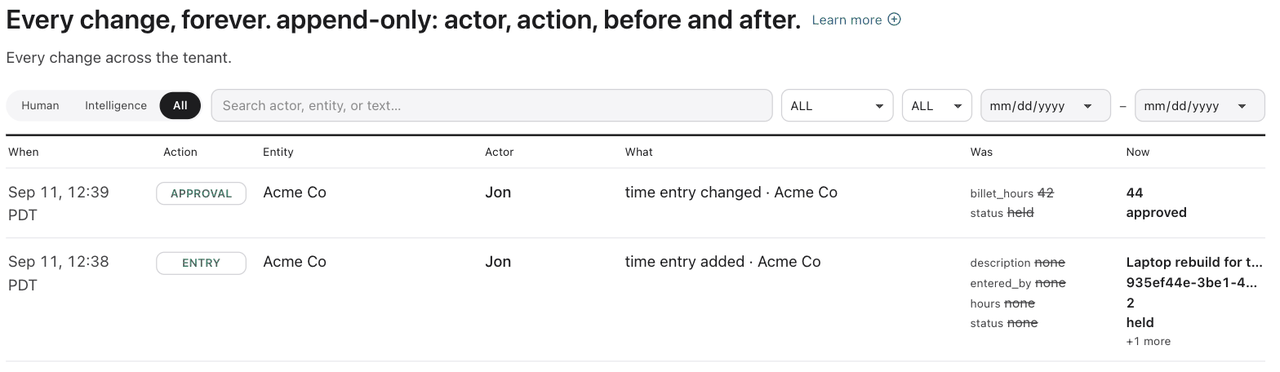
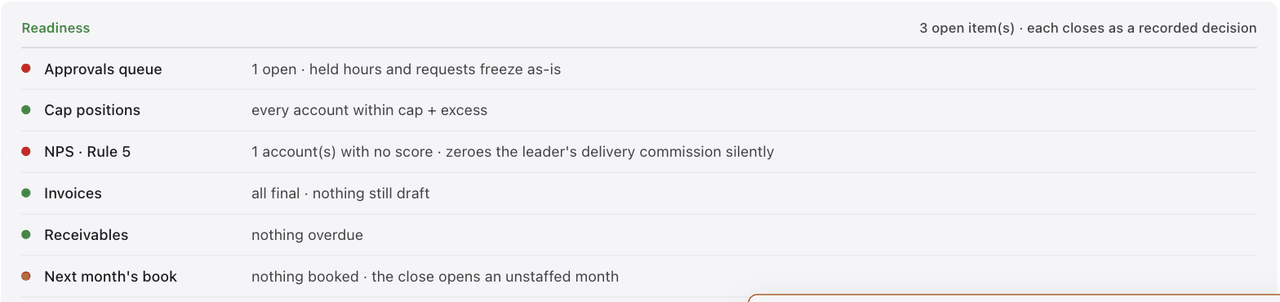
Two recordings on the record. A specialist’s half hour on what the government asks of a contractor’s timekeeping, including the rule that a correction keeps the original, and FloQast’s six-minute explainer on what a month-end close is and how long one takes, for anyone whose bookkeeper has never had time to explain it.
After the last row. The ledger and the spreadsheet.
Two things happen after the table too, and they are the two systems every firm already has: the ledger where the month ends, QuickBooks Online or Xero, and the spreadsheet where the money side has lived until now. Every tool in the table syncs to the ledger, and Ceed hands the ledger documents, so this is the second place the field is credited, and the sync deserves a closer look than a cell would allow.
The pain is that the sync carries less than the word suggests. Harvest’s help center: “Retainer invoices are not copied to Xero or QuickBooks Online because they are not considered income until the money taken in from that invoice is used to offset a regular invoice.” For a firm on retainers, which is most of the firms this blog is written for, the highest-value invoices are the ones the integration declines to carry. Harvest also says time and expenses “can’t be directly copied or synced” to either ledger, only as lines on an invoice, one way. Toggl: “The Track invoice and the QuickBooks invoice are not directly connected. Updating one will not update the other,” and there is no Xero. Clockify sends time, not invoices, and not to QuickBooks Desktop, not to Simple Start, and not if QuickBooks has its Payroll feature enabled. Hubstaff sends time and rates, says a direct integration for invoicing “is not yet available,” and has no Xero either. Everhour has the best story of the five: it mirrors clients both ways and exports invoices as drafts with the status read back. Ruddr, a smaller tracker, documents the retainer workaround the category shares: six setup steps and, on every invoice, a manual line that offsets the whole amount so that “This will result in a zero dollar invoice.” The suites go deeper. Accelo syncs invoices, payments, contacts, items and bills both ways with no plan gate. Scoro requires its Spend and Invoice apps. Productive syncs invoices on Professional while it only lets you create them on Ultimate. Kantata documents no native QuickBooks or Xero app at all. IDC’s study for Kantata, published in February 2026 from a hundred firms and paid for by a vendor with a conclusion in mind, still put a number on the seams: “close to 180 steps end-to-end, 40 plus documents to track” in the administrative process, and up to a fifth of skilled people’s time in administration. Deltek’s 2026 Clarity study of government contractors found 85% of firms using two to five tools on a single project and 5% fully integrated. On r/Bookkeeping in January 2026 a new S corporation owner asked why wages were counted twice, once from the Gusto connector’s journal entry and once from the bank feed, which is what two systems do to one event when nobody has told them it is the same one.
Invoices and payout statements come out of Ceed as documents for the ledger you already use, and a bookkeeper enters them, a retainer as a retainer and an approved extra as its own line, because the document says so. On the sync itself, Everhour and Accelo have the most complete story, and we say so here rather than leave it off the page.
The spreadsheet is the other system, and the field’s answer to it is implementation. Deltek’s 2026 Clarity study of architecture and engineering firms found 43% “heavily reliant on spreadsheets for accounting and invoicing.” Promethean’s 41% of agencies that do not track project margin are running their margin, if anywhere, in a sheet. And the suites built to replace it are built for someone else. Kantata wrote in July 2026 that implementation takes “6-8 weeks for mid-size orgs and 3-6 months for enterprise-scale” rollouts, that it is built for firms with “50+ billable resources,” and that this is “an intentional fit statement.” Accelo’s pricing page says most teams are up and running “in a matter of weeks.” A small-business IT supervisor on G2 in December 2025 put it at two to three months, and another reviewer was quoted more than $5,000 for training. Promethean counts 87% of the 71,000 digital agencies it evaluated at fewer than fifty full-time employees. The suites are built for the other 13%. The spreadsheet is what the 87% run on, and it is the one tool that already holds the firm’s own leak.
A firm brings its agreements and its people into Ceed by hand, on the day it signs up, and the first month is a month. There is no implementation, no onboarding fee and no minimum, and nothing to pay until the first invoice. The spreadsheet stays as long as the firm wants a second copy of what the record already holds.
The clearest twenty minutes on what two systems do to one event is Clara CFO Group’s walkthrough of how duplicates get into QuickBooks Online, and how to keep them out.
Seats, tiers, meters. Or 0.1%.
Row ten is the price, and in 2026 it has a story. On 20 August 2026 the BBC reported that Harvest, the time tracker bought by the Italian company Bending Spoons in 2025, had told customers on old plans that their bills would rise at renewal by as much as fifteen times. Richard Haldenby, who runs the UK consultancy Salentis with up to fifteen staff and has used Harvest across three companies for fifteen years, saw his monthly bill go from $130 to $2,110. Another customer in the United States saw an annual bill go from $2,800 to $23,000. Harvest told the BBC that customers on legacy plans, some from 2011, faced the larger increases as the product had become more capable, and that they were notified thirty and ten days before renewal. Mark Peacock, a pricing consultant, told the same reporter there was no way for a customer to work out the cost until the bill arrived. On Hacker News the story reached 112 points, and a customer of thirteen years posted the renewal email: “You will be automatically billed $2,199.50 for your new monthly plan,” with a usage-based alternative estimated at $416.05. Another canceled after twenty years when the renewal came in at a 1,400% increase and, during the cancellation, fell to a 300% increase. In the r/HarvestApp thread that opened when the ownership notice arrived in January 2026, a user since 2011 predicted the pattern, and by August another had learned of the change from the credit card charge: an annual bill of about $2,000 had become about $22,000.
The model behind the numbers is the row’s subject. Until the change Harvest charged a flat fee per seat. Now its Teams plan is $9 a seat a month billed annually, $11 monthly, and Enterprise $14 and $17.50, and on top of the seats it meters projects, tasks, clients, invoices created and, on its Flex billing, the dollar amount invoiced, in tiers whose per-unit prices its pricing page does not publish. Below its top tiers it adds its own surcharge to card and bank payments on invoices. Scheduling is a separate product, Forecast, on a separate bill. A small-firm operator on Hacker News described what per-seat pricing plus tier moves feel like from below: “To run the software it makes little difference whether there are 3 users or 6 users, yet the total cost of those 3 additional users was an additional 500 dollars.” The acquirer’s model is worth knowing too. Bending Spoons listed on Nasdaq in July 2026, agreed to buy Airtable weeks before this post, and on 10 September 2026 agreed to buy Miro at an enterprise value of $1.355 billion, a company valued at $17.5 billion in 2022. Hiten Shah’s eight minutes on how the company operates what it buys had 81,700 views by the time this post went up.
Another brutal M&A. Miro, founded in 2011 and valued at $17.5B 4yrs ago, is getting acquired by Bending Spoons, founded 2013, at ~2.3x ARR. After Airtable, another unfortunate victim of the SaaS bust at ~10x down from peak.
The rest of the field prices in five shapes, all read from the pricing pages on 12 September 2026. Ignition is $39 to $399 a month billed annually, $49 to $499 billed monthly, across four tiers metered on active clients, twenty to six hundred, and users, with overage charged on the peak count in the period, plus card fees of 1.3% to 3.6% and 30 cents and bank fees from 1% and 30 cents, capped at $5, with 0.3% more above $3,000. Anchor is $0 a month and $5 per payment received, bank transfers free, cards at 2.9% and 30 cents paid by the client, and unlimited users, which is the only other price in the table that is nothing until a client pays. Toggl Track is $9 a user a month on Starter and $16 on Premium, $6 and $10.67 billed annually, and its free plan now stops at three users. Clockify is $4.99 to $14.99 a seat a month, $3.99 to $11.99 annually, and “Every active or invited user listed on your Team page occupies one paid seat.” Hubstaff is $7 to $25 a user, with a minimum of two seats and integrations gated to Grow and above. Everhour is $8.50 a seat billed yearly with a minimum of five, so its real floor is $42.50 a month for a firm of two. Scoro is $17 to $57 a user a month with a minimum of five. Productive is about $10 to $25 a user with a minimum of three, and invoicing only on Ultimate. Accelo and Kantata publish no price at all. Kyle Poyar’s 2025 survey of more than 240 software companies found seat-based pricing falling from 21% to 15% of them in a year, and his reason is the row’s thesis: “Value is disconnected with how many people are logging in.”

The arithmetic, in full. A firm of ten people invoicing $1.5 million a year pays Ceed $1,500 for the year. On seats alone the trackers land nearby at that size: Clockify Pro at $959 a year, Everhour at $1,020, Harvest Teams at $1,080 before usage, Toggl Premium at $1,280. Ignition Core is $1,188 a year before payment fees, and Anchor is $5 for each payment received, so a hundred payments in a year is $500 on top of doing the collecting. The suites start higher, Productive Professional at about $2,900 a year without invoicing and Scoro’s full bundle at $6,840 before onboarding, and Accelo and Kantata will tell you on a call. On one invoice the comparison with Anchor cuts both ways: on a $1,000 invoice Anchor’s $5 is half a percent and Ceed’s is $1, and on a $20,000 invoice Anchor’s $5 is a fortieth of a percent and Ceed’s is $20. So the argument is not that Ceed is cheaper at ten people. It is the shape of the bill. It rises and falls with what you invoice and with nothing else. Adding a contractor costs nothing, a quiet month costs nothing, no feature moves to a higher tier, there is no minimum, and the rate never moves. Invoice $200,000. Pay $200. That is the pricing page.
What we changed on the comparison page.
Reading eleven help centers in one day changed the page in five places, and the page now carries 2026-09-12. The Slack row now says the trackers log an hour with timers and slash commands, not only with timers, and that Anchor reads the hours of trackers synced to QuickBooks Online. The hold row for the trackers now says the alert comes within the hour or the morning after, since Clockify’s arrives within about forty minutes and Harvest’s at 3:00 a.m. The close row for the trackers and the suites read No and now reads No, locks an administrator can lift, which credits Harvest’s and Toggl’s timesheet locks, Productive’s month close on Ultimate, Kantata’s one lock date and Scoro’s locked weeks, none of them a record nobody can rewrite. The price row now gives Ignition’s range as $39 to $399 a month billed annually and $49 to $499 monthly, plus payment fees, gives the trackers as $4 to $25 a seat with minimums at some and usage meters at Harvest, and records that Accelo and Kantata publish no price. And the paragraph on the field now names Everhour beside Hubstaff among the tools that refuse an hour past the budget. If a row is still wrong, write to us, and we will fix it and say so.
What the books say.
Seven books, three of them on why a record has to be a record, two on standing beside a field, and two for the rows about shares and commissions.
- Double EntryJane Gleeson-White, 2012. How the merchants of Venice invented the ledger, and why a system that records every movement twice became the thing a business is trusted on.
- The ReckoningJacob Soll, 2014. Financial accountability from the Medici to the modern state, and what happens to institutions whose books stop being believed.
- Designing Data-Intensive ApplicationsMartin Kleppmann, 2017. The engineer’s case for the append-only log as the source of truth, which is the row about the close in a different vocabulary.
- Obviously AwesomeApril Dunford, 2019. Positioning as the choice of what to be compared against, which is what a comparison page is.
- Managing the Professional Service FirmDavid H. Maister, 1993. The economics of a firm of experts, including the arithmetic of margin, the ratio of juniors to partners, and the hour that never reaches the invoice.
- Venture DealsBrad Feld and Jason Mendelson, fourth edition, 2019. How startup equity actually works, for any firm that has been offered some instead of a fee.
- Compensating the Sales ForceDavid J. Cichelli, third edition, 2018. The standard text on commission plans, including the policies a firm has to write before any software can compute one.
Three conversations about the field.
The firm behind Ceed also hosts The Security Podcast of Silicon Valley, 103 conversations since 2021 with the people who build and run security. Three of them are about standing beside a field of incumbents, buying fewer tools, and records an auditor will read.
- 42
Avery Pennarun, co-founder and CEO of TailscaleMay 2024 · Building the anti-Google from the bottom up, which is what a small product does when it stands next to giants.
- 63
Kabir Mathur, CEO of LeenFebruary 2025 · Buying more tools can make things worse, and the case for one record the others work from.
- 56
Kayne McGladrey, Field CISO at HyperproofOctober 2024 · What a 10-K asks a company to prove, and why documentation is the thing that survives the conversation.
Ceed is for firms that sell their team’s time: fractional CFO, CISO, CMO and CTO practices, security and engineering boutiques, consultancies and agencies up to fifty people. If you have read this far you know which rows your firm is losing. Sign up and see them with your own numbers. Nothing to pay until your first invoice.
Sign upOr write to hello@ceed.so.
Questions.
What does Ceed do that Harvest, Toggl and Clockify do not?
Three things, as of 12 September 2026. It holds an hour that would push a client over budget for a named person’s decision the moment it is logged, where the trackers email an alert afterward, Harvest’s at 3:00 a.m. the next morning and Clockify’s within about forty minutes. It computes the invoice, the contractor’s payout statement and the commission from the same approved entries and the agreement’s terms, including equity taken as payment. And it closes the month as a record on an append-only trail, where every lock in the trackers is a permission an administrator can lift. The trackers have timers, retainers at Harvest and QuickBooks and Xero syncs, and the credit for those is theirs.
Does Ceed replace Ignition or Anchor?
Ignition and Anchor turn a proposal into a signed agreement with a payment method attached and collect the invoices automatically, and neither tracks an hour or knows what an engagement cost. Ceed holds the hours against the agreement, computes the invoice and closes the month, and it never touches the money. A firm runs Ignition or Anchor for the signing and the collecting and Ceed for the record in between, and the invoice Ceed freezes is a document one of them, or your bank, collects. They stay where they are.
Which time trackers refuse an hour over budget, and which hold it?
By their own help centers on 12 September 2026, Hubstaff refuses manual entries from members once a project budget is reached and can stop timers, Everhour refuses everyone including administrators and stops timers, and Productive on its Professional and Ultimate plans either refuses the entry or accepts it and blocks its approval. Harvest, Toggl and Clockify alert afterward and refuse nothing. Anchor checks the hours against a pre-approved cap when the invoice is written. None of them holds the hour for a person’s decision with either answer kept on the record, which is what Ceed does.
Does Ceed sync to QuickBooks or Xero?
Invoices and payout statements come out of Ceed as documents for the ledger you already use, and a bookkeeper enters them. Every tool in the comparison table has a sync, and they differ: Harvest copies invoices one way and will not copy retainer invoices, Toggl creates a QuickBooks invoice it does not stay connected to and has no Xero, Clockify and Hubstaff send time rather than invoices, and Everhour mirrors clients both ways and exports invoices as drafts.
Why is Ceed priced as a share of invoices instead of per seat?
Because the bill should rise and fall with the firm. Ceed is 0.1% of what you invoice, with no seats, tiers or minimums, so adding a contractor costs nothing and a month you invoice nothing costs nothing, and the rate never moves. Per-seat tools charge for every person who logs an hour, several have minimums of two to five seats, features move between tiers, and in 2026 Harvest’s move to seats plus usage meters raised some renewals by more than tenfold. At ten people the dollars are close. The difference is what the bill does when you hire, when you invoice, and at renewal.
Is Ceed a suite like Accelo, Scoro, Kantata or Productive?
No. The suites run the whole operation of a services firm, projects, tasks, scheduling, sales and reporting, for firms large enough to implement one, and Kantata says its own fit begins at fifty billable people. Ceed runs the money side only: the hours against each client’s budget, the invoice from the agreement, the payouts and commissions from the same entries, margin per client each morning, and the month close. Your project tool, your chat and your ledger stay where they are.
 Jon McLachlan is a co-founder of Ceed and of YSecurity, which ran its own books on a spreadsheet before it built the record it wanted. Published 12 September 2026. Corrections to hello@ceed.so, and they are dated when made.
Sources
- Ceed, Where Ceed stands, the comparison page, dated 2026-09-12 after the corrections described above. Every vendor page below was read on 12 September 2026 unless another date is given.
- Tara E. Adams, “Practitioner engagement letters: Strategies for increasing compliance”, The Tax Adviser, 30 November 2025. https://www.thetaxadviser.com/issues/2025/nov/practitioner-engagement-letters-strategies-for-increasing-compliance/. Sarah Beckett Ference, “Tips for writing CAS engagement letters”, Journal of Accountancy, 1 April 2026. https://www.journalofaccountancy.com/issues/2026/apr/tips-for-writing-cas-engagement-letters/ (read 12 September 2026).
- Intuit QuickBooks, “2026 Small Business Late Payments Report”, 7 July 2026. https://quickbooks.intuit.com/r/small-business-data/small-business-late-payments-report-2026/. Xero Small Business Insights, United States, June quarter 2026, published 30 July 2026. https://www.xero.com/us/resources/small-business-insights/latest-united-states/. Ignition, “The 2025 Agency Pricing & Cash Flow Report”, 22 May 2025, 273 respondents. https://www.ignitionapp.com/news/2025-agency-pricing-cashflow-report. Clio, Legal Trends Report 2025, law firm benchmarks. https://www.clio.com/resources/legal-trends/benchmarks/ (all read 12 September 2026).
- Ignition: “Ignition powers customers’ revenue growth, driving $3.1B through the platform in 2025”, 4 December 2025, https://www.ignitionapp.com/news/ignition-powers-customers-revenue-growth-driving-3-1b-through-the-platform-in-2025. “Ignition launches AutoCollect”, 8 May 2025, https://www.ignitionapp.com/news/ignition-launches-autocollect-to-end-the-business-chase-for-late-payments. “Instant Bill”, 8 August 2023, https://www.ignitionapp.com/news/ignitions-instant-bill-new-feature-turns-scope-creep-into-profits-for-professional-services. Payments guide, help center, 4 September 2025, https://support.ignitionapp.com/en/articles/12062235-ignition-payments-guide-3-ways-to-get-paid-to-boost-cash-flow. Integrations, https://www.ignitionapp.com/integrations. Business insights dashboard, https://www.ignitionapp.com/product/business-intelligence-dashboard. Pricing, https://www.ignitionapp.com/pricing, with the annual floor confirmed at https://www.ignitionapp.com/compare/ignition-vs-anchor and the tier prices from Proposify (23 March 2026) and Capterra (2026). Payment fees, help center, 11 September 2025, https://support.ignitionapp.com/en/articles/12134812-ignition-payments-faq. Active clients and overage, help center, 24 July 2026, https://support.ignitionapp.com/en/articles/12053209-managing-your-active-client-numbers-and-overage-charges (all read 12 September 2026).
- Anchor: pricing, https://www.sayanchor.com/pricing. Agreements, https://www.sayanchor.com/features/agreements. Compare, https://www.sayanchor.com/compare. “Anchor Lands $20 Million in Series A Funding”, PR Newswire, 30 January 2025, https://www.prnewswire.com/news-releases/anchor-lands-20-million-in-series-a-funding-to-eliminate-invoicing-and-payment-inefficiencies-for-small-to-medium-accounting-firms-302364348.html. “Anchor Unlocks Industry-First Auto-Billing for Any Time Tracking Software”, GlobeNewswire, 23 June 2025, https://www.globenewswire.com/news-release/2025/06/23/3103748/0/en/Anchor-Unlocks-Industry-First-Auto-Billing-for-Any-Time-Tracking-Software.html (all read 12 September 2026).
- 2Bobs, “Is AI Going to Kill Labor-based Pricing?”, David C. Baker and Blair Enns, 25 March 2026. https://2bobs.com/podcast/is-ai-going-to-kill-labor-based-pricing. AffinityLive, now Accelo, “Time is Money”, survey of more than 500 professionals, 2014. https://help.accelo.com/assets/Uploads/WhitePaper-TimeIsMoney.pdf. Gretchen Gavett, “Workers Are Bad at Filling Out Timesheets, and It Costs Billions a Day”, Harvard Business Review, 12 January 2015. https://hbr.org/2015/01/workers-are-bad-at-filling-out-timesheets-and-it-costs-billions-a-day (all read 12 September 2026).
- Hacker News: “Launch HN: PointOne (YC W24), Automated time tracking for lawyers”, 27 March 2024, 137 points, comments by bdamm, noleary and pkilgore, https://news.ycombinator.com/item?id=39842617. jiggawatts, 5 September 2024, https://news.ycombinator.com/item?id=41460998. jamzi, “Show HN: I built a Slack app to automate timesheets and project tracking”, 7 November 2024, https://news.ycombinator.com/item?id=42077097. doodlebugging, 21 April 2024, https://news.ycombinator.com/item?id=40107820. “Ask HN: How to deal with a client who refuses to pay an invoice in full”, 26 June 2023, https://news.ycombinator.com/item?id=36486552. rimbo789, 2 September 2025, https://news.ycombinator.com/item?id=45101282. brudgers, 29 January 2024, https://news.ycombinator.com/item?id=39180201 (all read 12 September 2026).
- Slack and reminders, vendor help centers: Harvest, https://support.getharvest.com/hc/en-us/articles/360048180892-Slack and https://support.getharvest.com/hc/en-us/articles/360053255031-What-are-all-the-notifications-emails-Harvest-sends-and-how-do-I-enable-disable-each-one. Toggl Track, updated 24 July 2026, https://support.toggl.com/en-us/article/slack-integration-1nxe3jd/ and https://support.toggl.com/en-us/article/time-tracking-reminders-bpyngg/. Clockify, https://clockify.me/help/integrations/integrations and https://clockify.me/help/getting-started/getting-started-as-admin-and-workspace-owner/set-up-alerts-reminders-for-your-workspace-members. Hubstaff, https://support.hubstaff.com/integrations-overview/. Everhour, https://everhour.com/integrations/slack. Productive, https://help.productive.io/en/articles/16119831-slack-integration-general-overview. Scoro, https://support.scoro.com/hc/en-us/articles/23898177865101-Slack-integration. Kantata, https://knowledge.kantata.com/hc/en-us/articles/115002779313-Slack-Integration-Overview (all read 12 September 2026).
- Teamwork.com, “6 Strategic Shifts for 2026”, research with more than 1,000 senior business leaders. https://www.teamwork.com/2026-strategic-shifts/. Thomson Reuters Institute, “Law Firm Billing Efficiency and Write Downs”, 245 respondents, 2023, https://www.thomsonreuters.com/en-us/posts/wp-content/uploads/sites/20/2024/04/Law-Firm-Billing-Write-Downs-2023-1.pdf, and “The AI-driven future of legal efficiency”, 315 respondents, 2025, https://www.thomsonreuters.com/en-us/posts/wp-content/uploads/sites/20/2025/04/The-AI-driven-future_2025.pdf. Ryan Lazanis, “Scope Creep: The Two Root Causes”, Future Firm, 8 September 2026, https://futurefirm.co/scope-creep-the-two-root-causes/ (all read 12 September 2026).
- Budget alerts and refusals, vendor pages: Harvest home page, https://www.getharvest.com/, and “Budget email alerts”, https://support.getharvest.com/hc/en-us/articles/4407283487629-Budget-email-alerts. Clockify, https://clockify.me/project-budgeting, “Alerts”, updated 28 April 2026, https://clockify.me/help/projects/alerts, and “Not receiving alerts”, updated 24 April 2026, https://clockify.me/help/troubleshooting/project-issues/not-receiving-alerts. Toggl Track, “Alerts”, updated 16 June 2026, https://support.toggl.com/en-us/article/alerts-t70yio/. Hubstaff, “Project level budgets”, https://support.hubstaff.com/project-level-budgets/. Everhour, “Budgeting”, updated 16 June 2023, https://support.everhour.com/article/501-budgeting, and https://everhour.com/project-budgeting. Productive, “Budget Overrun Limitations”, updated 23 February 2026, https://help.productive.io/en/articles/12570473-budget-overrun-limitations-disable-time-tracking-at-the-service-limit. Scoro, “Watchdog”, https://support.scoro.com/hc/en-us/articles/12405325244813-Watchdog. Accelo, “Triggers”, https://help.accelo.com/webinars/best-practices/triggers/. Kantata, “Project Admin Box: Budget Tab”, https://knowledge.kantata.com/hc/en-us/articles/6618654476827-Project-Admin-Box-Budget-Tab (all read 12 September 2026).
- Posts on X: @KarlSakas, 26 August 2020, https://x.com/KarlSakas/status/1298626512623742982. @deedydas, 10 September 2026, https://x.com/deedydas/status/2098060584134873286. Tanay Jaipuria, “Bending Spoons S-1 Breakdown”, article on X, 28 July 2026, https://x.com/tanayj/status/2081917680345370723. Like counts as read 12 September 2026.
- Invoices and write-downs: LeanLaw, “When Should You Write Off Time? And When Should You Write It Down?”, 29 October 2025, citing LexisNexis (2014) and Clio, https://www.leanlaw.co/blog/when-should-you-write-off-time-and-when-should-you-write-it-down/. Thomson Reuters Institute, “Law Firm Rates Report 2026”, 20 October 2025, https://www.thomsonreuters.com/en-us/posts/legal/law-firm-rates-report-2026/. Versapay with Wakefield Research, “The impact of poor invoice processing”, 18 July 2023, https://www.versapay.com/resources/poor-invoice-processing-impact. Harvest, “Retainer invoices FAQ”, https://support.getharvest.com/hc/en-us/articles/28454626267917-Retainer-invoices-FAQ. Toggl Track, “Creating invoices”, updated 5 August 2026, https://support.toggl.com/en-us/article/creating-invoices-in-toggl-track-1irsvlv/. Clockify, “Invoicing”, updated 23 April 2026, https://clockify.me/help/projects/invoicing. Hubstaff, “Creating an invoice”, https://support.hubstaff.com/creating-invoice-overview/. Everhour, “Editing invoiced time”, https://support.everhour.com/article/437-editing-invoiced-time. Productive pricing, https://productive.io/pricing/. Scoro pricing, https://www.scoro.com/pricing/ (all read 12 September 2026).
- Equity as fees: Adam Lashinsky, “Silicon Valley: The Lawyers Got Screwed Too”, Fortune, 27 May 2002, https://money.cnn.com/magazines/fortune/fortune_archive/2002/05/27/323671/index.htm. Kate Park, “Design firm Zypsy will do $100K worth of work for 1% equity for early-stage startups”, TechCrunch, 16 April 2024, https://techcrunch.com/2024/04/16/design-zypsy-ideo-work-equity-startups. Carta, “Advisory shares: what founders need to know”, 6 November 2025, https://carta.com/learn/startups/equity-management/advisory-shares/. Founder Institute, FAST agreement, version 3, July 2026, https://fi.co/fast. u/i_am_exception, “Client willing to give equity instead of money cash, what should I do?”, r/freelance, 27 March 2021, 44 points, 66 comments, https://www.reddit.com/r/freelance/comments/meppvm/. Internal Revenue Service, Revenue Ruling 2004-37, https://www.irs.gov/pub/irs-drop/rr-04-37.pdf. PwC Viewpoint, Revenue from contracts with customers, section 4.5, noncash consideration, https://viewpoint.pwc.com/dt/us/en/pwc/accounting_guides/revenue_from_contrac/revenue_from_contrac_US/chapter_4_determinin_US/45noncash_considerat_US.html (all read 12 September 2026).
- Margin and bookings: Promethean Research, “How Profitable are Digital Agencies?”, 19 April 2026, https://prometheanresearch.com/how-profitable-are-digital-agencies/, “2026 State of Digital Services”, 119 responses, fielded February 2026, https://prometheanresearch.com/2026-state-of-digital-services-digital-agency-industry-research/, and “Digital Agency Industry Report”, https://prometheanresearch.com/digital-agency-industry-report/. SPI Research, 2026 Professional Services Maturity Benchmark, 509 firms, as summarized by Deltek, 30 July 2026, https://www.deltek.com/resources/articles/professional-services-benchmarks/. Sapien Global Services, “Fully booked, barely profitable”, 3 June 2026, https://sapienglobalservices.com/case-studies/fully-booked-barely-profitable-why-a-busy-agencys-hard-work-didnt-reach-the-bottom-line/. u/KeyserSoze0103, “Talked with 40 agency owners. None knew their real margin.”, r/agency, 7 July 2026, 40 comments, https://www.reddit.com/r/agency/comments/1upwzvf/. u/IQsDigital, “What tools do you use for tracking profitability?”, r/agency, 20 January 2025, 12 points, https://www.reddit.com/r/agency/comments/1i5r434/. Runn, “The State of Resource Management in 2026”, 2 April 2026, https://www.runn.io/blog/resource-management-statistics. Rob Black, “77 months in: What I learned starting a cybersecurity company”, Fractional CISO, 29 November 2023, https://fractionalciso.com/77-months-in-what-i-learned-starting-a-cybersecurity-company/ (all read 12 September 2026).
- Profitability and scheduling, vendor pages: Harvest, “Profitability report”, https://support.getharvest.com/hc/en-us/articles/25342727197581-Profitability-report, and Forecast pricing, https://www.getharvest.com/forecast/pricing. Toggl pricing, https://toggl.com/pricing. Clockify, “Tracking project profitability”, https://clockify.me/help/projects/tracking-project-profitability, “Labor cost”, https://clockify.me/help/reports/labor-cost, and “Scheduling”, https://clockify.me/help/projects/scheduling. Hubstaff, “Reports overview”, https://support.hubstaff.com/reports-overview/, and scheduling, https://hubstaff.com/employee-scheduling-software. Everhour features, https://everhour.com/features. Productive, “Cost rates”, updated 23 June 2026, https://help.productive.io/en/articles/2179644-understanding-and-setting-up-cost-rates-in-productive, and the Resource Planner, https://help.productive.io/en/articles/9031823-how-to-book-schedule-people-for-services-in-the-resource-planner. Scoro, “Resource bookings”, https://support.scoro.com/hc/en-us/articles/25995337245197-Resource-bookings-an-overview. Kantata, “Resource Center overview”, https://knowledge.kantata.com/hc/en-us/articles/115004362073-Resource-Center-Overview (all read 12 September 2026).
- Payouts and commissions: Fractional Jobs, “The Fractional FAQ”, https://www.fractionaljobs.io/faq. MBO Partners, “State of Independence 2025”, 9 September 2025, https://www.mbopartners.com/state-of-independence/. Tanja Trkulja, “How to track contractor hours”, Clockify, 16 December 2025, quoting Shawn Jahromi and Guillermo Triana, https://clockify.me/blog/tracking-time/track-contractor-hours/. Hubstaff, “Payroll overview”, https://support.hubstaff.com/payroll-overview/, “Automatic payments”, https://support.hubstaff.com/automatic-payments-payroll/, and “Locked time in Hubstaff”, https://support.hubstaff.com/locked-time-in-hubstaff/. QuotaPath, “What Finance and RevOps Lose by Waiting to Ditch Commission Spreadsheets”, May 2026, quoting Ryan Milligan and Jordan Rupp, https://www.quotapath.com/blog/commission-spreadsheets-lose/. Drew McLellan, “How to Calculate Advertising Agency Commission Rates”, Agency Management Institute, updated 2 February 2023, https://agencymanagementinstitute.com/advertising-agency-commission-rates/. u/Music_Nature_Tech, “Sales Compensation Structure for your agency?”, r/agency, 29 September 2025, https://www.reddit.com/r/agency/comments/1ntkra7/ (all read 12 September 2026).
- The record: Defense Contract Audit Agency, “Information for Contractors”, DCAAM 7641.90, revised 14 November 2023, enclosure 3, https://www.dcaa.mil/Portals/88/Documents/Guidance/CAM/Information%20For%20Contractors%20DCAAM%207641_90.pdf. Federal Acquisition Regulation 31.201-2(d), https://www.acquisition.gov/far/31.201-2. American Bar Association, Model Rule 1.15, https://www.americanbar.org/groups/professional_responsibility/publications/model_rules_of_professional_conduct/rule_1_15_safekeeping_property/. APQC, 2017, median close of 6.4 days across 2,300 organizations, via Numeric, “How long does month-end close take”, https://www.numeric.io/blog/how-long-does-month-end-close-take (all read 12 September 2026).
- Locks and approvals, vendor pages: Harvest, “Submitting and approving timesheets”, https://support.getharvest.com/hc/en-us/articles/360048181832-Submitting-and-approving-timesheets, and “Timesheet auto lock and manual lock”, https://support.getharvest.com/hc/en-us/articles/46563806657421-Timesheet-auto-lock-and-manual-lock-Q-A. Toggl Track, “Locking time entries”, updated 16 June 2026, https://support.toggl.com/en-us/article/locking-time-entries-xsvs45/, and “Time Audits”, https://support.toggl.com/time-audits. Clockify, “Approval”, updated 8 July 2026, https://clockify.me/help/track-time-and-expenses/approval. Hubstaff, “Audit log”, https://support.hubstaff.com/audit-log/. Everhour, “Time approval”, updated 28 June 2022, https://support.everhour.com/article/473-time-approval-admin. Accelo, “Timesheet approvals”, https://help.accelo.com/guides/user/timers-timesheets-and-scheduling/timesheet-approvals/. Scoro, “Time locking”, https://support.scoro.com/hc/en-us/articles/12404798473997-Time-locking. Kantata, “Time Lock”, https://knowledge.kantata.com/hc/en-us/articles/115000813394-Time-Lock, and “Unlock Time”, https://knowledge.kantata.com/hc/en-us/articles/1260801848870-Unlock-Time. Productive, “Financial Month Closing”, updated 18 August 2025, https://help.productive.io/en/articles/10289783-financial-month-closing-closing-and-securing-financial-periods (all read 12 September 2026).
- The ledger and the spreadsheet: Harvest, “QuickBooks Online”, https://support.getharvest.com/hc/en-us/articles/360048686231-QuickBooks-Online, and “Xero and QuickBooks Online FAQ”, https://support.getharvest.com/hc/en-us/articles/13100941866125-Xero-and-QuickBooks-Online-FAQ. Toggl Track, “QuickBooks Online integration”, updated 16 June 2026, https://support.toggl.com/en-us/article/quickbooks-online-integration-17fgny8/. Clockify, “QuickBooks integration”, updated 4 August 2026, https://clockify.me/help/integrations-and-add-ons/quickbooks-integration. Hubstaff, “QuickBooks Online integration setup”, https://support.hubstaff.com/quickbooks-online-integration-setup/. Everhour, “Clients and invoices to QuickBooks Online, Xero, FreshBooks”, https://support.everhour.com/article/431-clients-invoices-to-quickbooks-online-xero-freshbooks. Ruddr, “How do I account for a retainer with Ruddr and QuickBooks Online”, https://help.ruddr.io/faqs-and-troubleshooting/ruddr-and-quickbooks-online/how-do-i-account-for-a-retainer-prepaid-services-with-ruddr-and-quickbooks-onlin. Accelo, “QuickBooks Online”, https://help.accelo.com/guides/integrations-guide/quickbooks/quickbooks-online/. Scoro, “QuickBooks integration”, https://support.scoro.com/hc/en-us/articles/12791227602701-QuickBooks-integration-overview-and-setup. Productive, “QuickBooks integration”, updated 17 February 2026, https://help.productive.io/en/articles/2179614-quickbooks-integration-setup-and-sending-invoices-to-quickbooks. IDC for Kantata, “New Study Finds that Professional Services Firms Lose 5 to 10% of Revenue by Failing to Adopt PSA Software”, Business Wire, 17 March 2026, 100 firms, https://www.businesswire.com/news/home/20260317646097/en/New-Study-Finds-that-Professional-Services-Firms-Lose-510-of-Revenue-by-Failing-to-Adopt-PSA-Software. Deltek, “Deltek Clarity global overview”, 2026 studies, https://www.deltek.com/resources/articles/deltek-clarity-global-overview/. u/SadieDC, “QB & Gusto Double Counting”, r/Bookkeeping, 17 January 2026, https://www.reddit.com/r/Bookkeeping/comments/1qey3r4/. Kantata, “Fact vs. Fiction: Busting the Biggest Myths About Kantata”, 17 July 2026, https://www.kantata.com/blog/article/fact-vs-fiction-busting-the-biggest-myths-about-kantata. Accelo pricing, https://www.accelo.com/pricing/, and reviews on G2, https://www.g2.com/products/accelo/reviews (all read 12 September 2026).
- Price: Laura Cress, “UK business hit by ‘daylight robbery’ 1500% price hike for invoicing software”, BBC News, 20 August 2026, https://www.bbc.com/news/articles/clyq011414eo. Hacker News, “Harvest hikes bills by 1500% after purchased by Bending Spoons”, 20 August 2026, 112 points, https://news.ycombinator.com/item?id=49374920, with the renewal email quoted by agsqwe, https://news.ycombinator.com/item?id=49376596. Smeevy, 10 September 2026, https://news.ycombinator.com/item?id=49646772. abejora, 10 September 2026, https://news.ycombinator.com/item?id=49642134. u/PulpFictionRoyale, “Purchase by Bending Spoons”, r/HarvestApp, January 2026, with comments through August 2026, https://www.reddit.com/r/HarvestApp/comments/1q25xpy/. Harvest pricing, https://www.getharvest.com/pricing, “Information about pricing plans”, https://support.getharvest.com/hc/en-us/articles/31447072608397-Information-about-pricing-plans, and “Does Harvest charge transaction fees for online payments”, https://support.getharvest.com/hc/en-us/articles/360048181212-Does-Harvest-charge-transaction-fees-for-online-payments. Bending Spoons, “Bending Spoons enters into a definitive agreement to acquire Miro”, investor newsroom, 10 September 2026, https://investors.bendingspoons.com/. Clockify pricing, https://clockify.me/pricing. Hubstaff, “Per-seat pricing”, https://support.hubstaff.com/per-seat-pricing/, and pricing guide, https://hubstaff.com/hubstaff-pricing-guide. Everhour pricing, https://everhour.com/pricing. Kantata pricing, https://www.kantata.com/pricing. Kyle Poyar, “The 2025 State of B2B Monetization”, Growth Unhinged, 4 June 2025, 240 or more companies surveyed, https://www.growthunhinged.com/p/2025-state-of-b2b-monetization (all read 12 September 2026).
- Recordings: Jonathan Stark, “How to Get Clients to Pay Faster: Get Paid 100% Upfront”, 5 July 2019, https://www.youtube.com/watch?v=uC3MN3tXntU. The Futur, “Hourly Billing Is Nuts, Stop Trading Time For Money”, with Jonathan Stark, 11 September 2018, https://www.youtube.com/watch?v=B1b7QlQILRo. 2Bobs, “Transcending Timesheets”, YouTube, 7 March 2022, https://www.youtube.com/watch?v=x-mwbljeDoM. Parakeeto, “Set up to Fail, Even with Perfect Projects”, Agency Profit Podcast 212, 16 December 2025, https://www.youtube.com/watch?v=b9kfCGU2eZU. Y Combinator, “Startup Advisor Equity? Pebble Watch Founder Eric Migicovsky”, 30 April 2019, https://www.youtube.com/watch?v=XvlKwwKfS5c. Parakeeto, “How to be Profitable at Any Size with Drew McLellan”, Agency Profit Podcast 217, 10 February 2026, https://www.youtube.com/watch?v=n2IsKsc2zMI. Hector Garcia CPA, “QuickBooks Online: Setup 1099 Contractors”, 18 January 2024, https://www.youtube.com/watch?v=b4R_Jf20tvY. 2Bobs, “The Complexities of Commission Culture”, YouTube, 3 February 2022, https://www.youtube.com/watch?v=KALbnNPSaI8. DCAA Compliance, “Timekeeping Requirements for Government Contractors”, 28 October 2013, https://www.youtube.com/watch?v=olttjkWofL4. FloQast, “How To Do the Month End Close, A Step-by-Step Explainer”, 30 December 2021, https://www.youtube.com/watch?v=3W8Wu3fY7FU. Financial Tech Lab by Clara CFO Group, “How to avoid duplicate transactions in Quickbooks Online”, 16 February 2023, https://www.youtube.com/watch?v=6tGb0-AzXEo. Hiten Shah, “This Italian startup makes $1.5B a year reviving zombie apps”, 9 February 2026, https://www.youtube.com/watch?v=6kLnodwtGh8. View counts as read 12 September 2026.
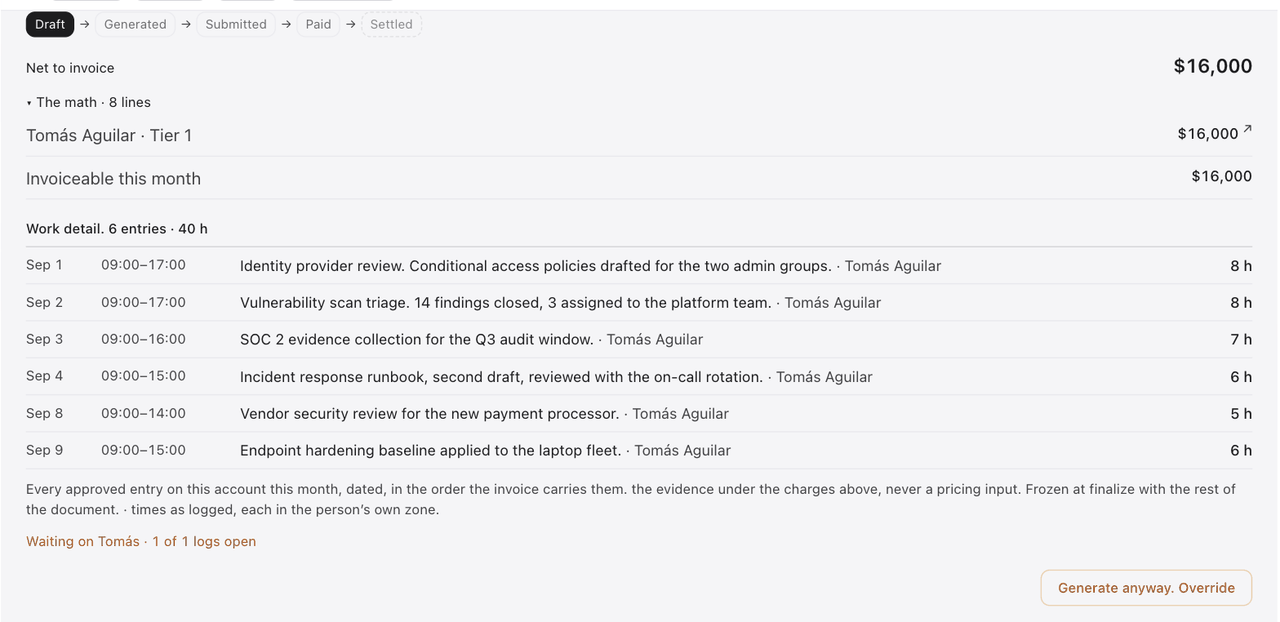
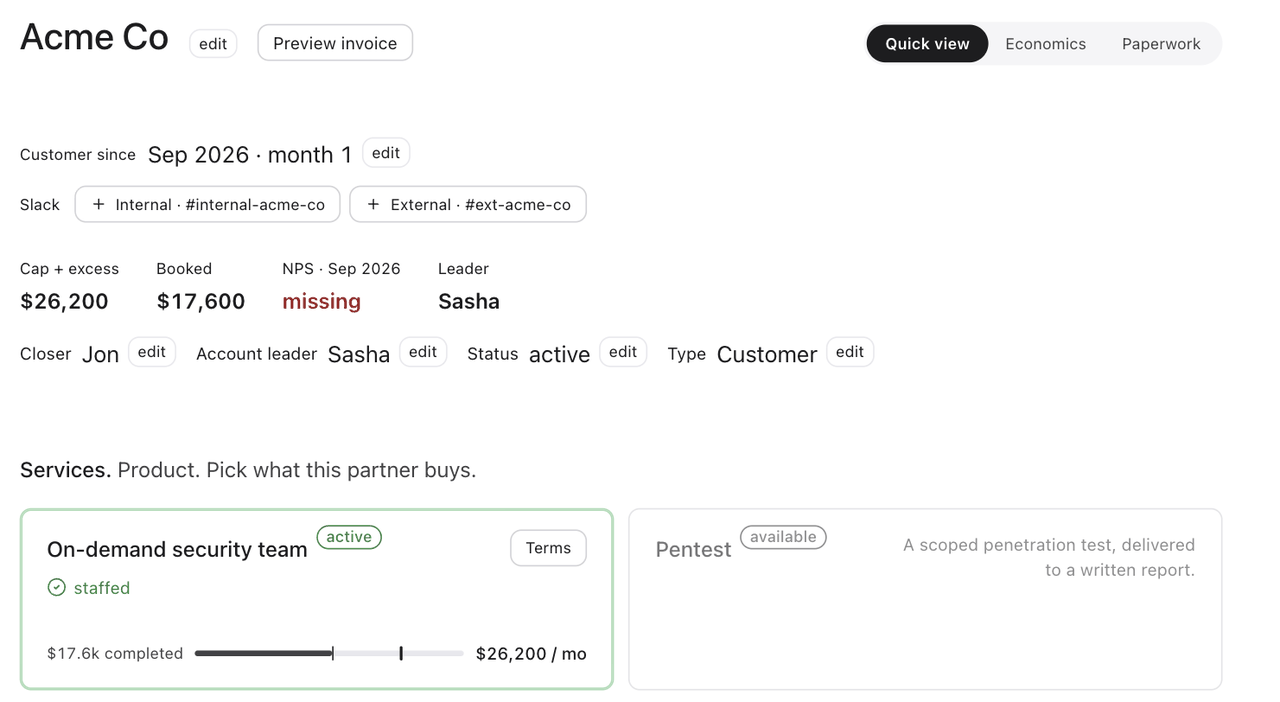
- Product pictures are of Ceed’s staging environment in September 2026, showing a demo account with invented names and figures.
- The Security Podcast of Silicon Valley, a YSecurity production: episode 42 with Avery Pennarun, 1 May 2024, https://ysecurity.io/podcast/42-avery-pennarun-co-founder-and-ceo-of-tailscale-the-anti-google-a/. Episode 63, “Buying more security tools? You might be making things worse”, with Kabir Mathur, 25 February 2025, https://ysecurity.io/podcast/63-buying-more-security-tools-you-might-be-making-things-worse/. Episode 56 with Kayne McGladrey, 15 October 2024, https://ysecurity.io/podcast/56-kayne-mcgladrey-field-ciso-at-hyperproof-sec-10-k-and-leaders/.